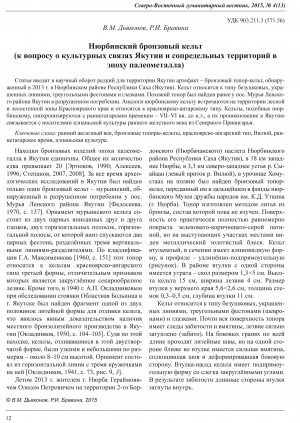
Статья вводит в научный оборот редкий для территории Якутии артефакт – бронзовый топор-кельт, обнаруженный в 2013 г. в Нюрбинском районе Республики Саха (Якутия). Кельт относится к типу безушковых, украшенных линиями, треугольными фестонами и глазками. Похожий топор был найден ранее у пос. Мурья Ленского района Якутии в разрушенном погребении. Аналоги нюрбинскому кельту встречаются на территории лесной и лесостепной зоны Красноярского края и относятся к красноярско-ангарскому типу. Кельты, подобные нюрбинскому, синхронизируются с раннетагарским временем – VII–VI вв. до н.э., а их проникновение в Якутию связывается с носителями цэпаньской культуры раннего железного века из Северного Приангарья.
The article describes a bronze axe (celt) discovered in 2013 near Nyurba in the Republic of Sakha (Yakutia). Such artifacts are rarely found on the territory of Yakutia. The celt belongs to the type of earless axes and is decorated with lines, triangular festoons and eyelets. A similar axe had been found earlier in a ruined burial near the village of Mur'ya in Lensky district of Yakutia. Analogs of the Nyurba Celt are found on the territory of the forest and steppe zones of Krasnoyarsk region and belong to the Krasnoyarsk-Angarsk type. Celts like Nyurba Celt are synchronized with the early stage of the Tagar culture and dated to the VII-VI centuries BC. Their penetration in Yakutia is associated with bearers of Tsepan’ culture of Northern Angara region dated to the Early Iron Age.