В данной научной статье представлены результаты комплексного исследования эндобионтных инфузорий кишечника якутских табунных лошадей с использованием морфологических и морфометрических методов. Видовой состав микроорганизмов кишечника представляет собой важный компонент микробиоты, оказывающий значительное влияние на здоровье и адаптацию животных к экстремальным условиям среды. Исследование включало сбор образцов кишечного содержимого у 80 здоровых якутских табунных лошадей, разводящихся в естественных условиях. В результате было обнаружено 15 видов инфузорий в кишечниках якутских табунных лошадей. Наиболее часто встречающимися видами оказались Cycloposthium edentatum, Holophryoides macrotricha и Bundleia elongata, в то время как Cycloposthium dentiferum, Spirodinium confusum, Cycloposthium ponomarevi и Allantosoma intestinale встречались редко. Также стоит отметить, что Allantosoma intestinale встречалась только у лошадей коренного типа. Интересным является обнаружение вида Cycloposthium ponomarevi у коренного и янского типа якутских лошадей, ранее выявленного только у куланов. Самыми крупными инфузориями являлись Cycloposthium ponomarevi, Cycloposthium plicatocaudatum, Cycloposthium edentatum и Cycloposthium dentiferum, мелкими размерами отличались Bundleia elongata и Holophryoides macrotricha. Отмечается высокая разнообразность инфузорий у якутских табунных лошадей по сравнению с культурными породами лошадей, что свидетельствует о значительном влиянии условий среды на микробиоту. Морфометрические параметры были определены для каждого вида, что позволяет лучше понять их адаптацию к условиям кишечника якутских табунных лошадей и их роль в пищеварении и усвоении питательных веществ. Выявленное разнообразие видов говорит о сложной экологической системе в кишечнике, где каждый вид выполняет свою уникальную роль. Эти результаты расширяют знание о микробиоте якутских табунных лошадей и подчеркивают важность инфузорий в поддержании их здоровья и выживаемости в условиях суровой среды. Исследование предоставляет базу для дальнейших экологических исследований. Однако, для полного понимания роли инфузорий в жизнедеятельности якутских табунных лошадей требуется дополнительное изучение механизмов взаимодействия между инфузориями и другими компонентами микробиоты кишечника.
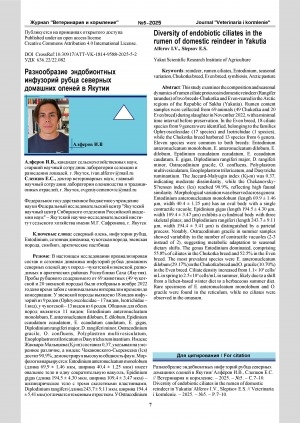
This scientific article presents the results of a comprehensive study on endobiotic ciliates inhabiting the gastrointestinal tract of Yakutian feral horses using morphological and morphometric methods. The species composition of gut microorganisms, which significantly influences the health and adaptation of animals to extreme environmental conditions, represents a crucial component of the microbiota. The investigation involved collecting gastrointestinal content samples from 80 healthy Yakutian horses living in natural conditions. As a result, 15 species of ciliates were identified in the gastrointestinal tracts of these horses. Among the most frequently encountered species were Cycloposthium edentatum, Holophryoides macrotricha, and Bundleia elongata, whereas Cycloposthium dentiferum, Spirodinium confusum, Cycloposthium ponomarevi, and Allantosoma intestinale were less common. It is noteworthy that Allantosoma intestinale was exclusively found in horses of the native type. Particularly interesting is the discovery of Cycloposthium ponomarevi in Yakutian-type horses, that was previously only observed in kulans. The largest ciliates identified were Cycloposthium ponomarevi, Cycloposthium plicatocaudatum, Cycloposthium edentatum, and Cycloposthium dentiferum, while Bundleia elongata and Holophryoides macrotricha were smaller in size. Compared to domesticated horse breeds, Yakutian feral horses exhibited a high diversity of ciliates in their gastrointestinal tract, indicating the significant influence of environmental conditions on the microbiota. Morphometric parameters were determined for each species, providing a better understanding of their adaptation to the gastrointestinal environment of Yakutian feral horses and their role in digestion and nutrient assimilation. The observed diversity of ciliate species highlights the complexity of the ecological system within the gastrointestinal tract, where each species fulfills a unique role. These findings expand our knowledge of the microbiota of Yakutian feral horses and underscore the importance of ciliates in maintaining their health and survival in harsh environmental conditions. These findings serve as a basis for further ecological research. However, to fully comprehend the role of ciliates in the life processes of Yakutian feral horses, additional investigations are required to explore the mechanisms of interaction between ciliates and other components of the gut microbiota.